We trace the problem upstream — then fix it at the source.
Sometimes it's a process fix. Sometimes it's AI and automation, done properly. Either way, the problem decides — not the tool.
Thirty years of experience. Delivered at AI speed.
This isn't vibe coding — which risks automating the wrong thing, or building something that doesn't hold up. Every fix is backed by real operational know-how and expertise, so what you get is built to last.
Direct to your business, without the consultancy baggage.
Waterfall Works is founder-led, bringing 30 years of hands-on experience across frontline operations, management, business analysis and change.
Today, that experience is combined with modern automation, data and AI tools to find the real cause of operational problems and put practical, proportionate fixes in place — built for small businesses that need someone who understands the whole operation, not a big consultancy sending in a delivery team.
EXPERIENCE THAT'S BEEN PUT TO THE TEST.
This isn't experience from a textbook or a training course. It's judgement built from being on the ground and in the thick of it — the process that broke, the deadline that slipped, the system that didn't scale — and having to put it right, not just write a report about it.
FEWER LAYERS.
MORE VALUE.
Consultancies often put partners, account managers and layers of juniors between the client and the work — and you pay for every one of them. Waterfall Works keeps the route direct, so more of what you spend goes into solving the problem.
PLAIN ENGLISH.
CLEAR ANSWERS.
We learn how your business works and explain it clearly. No technical speak, no consultancy jargon, and no unnecessary complexity — just a straightforward explanation of what's happening, what needs to change, and why.
NO DEFAULT FIX.
JUST THE RIGHT ONE.
There's no favourite tool we reach for, and no fixed methodology run on every client. We look at what's actually happening first, then decide — sometimes that means automation, sometimes it's nothing more complicated than a clearer process.
SUPPORT COMES AS STANDARD.
Every engagement includes a support period after delivery, so we stay close while the change beds in — making small optimisations and checking everything's working as it should. When that period ends, we don't disappear; we're still easy to reach if something needs a quick look.
Good businesses can still work better. Here's where we usually help.
None of this means something is wrong. Growth just brings more customers, more people, more systems — and more chances to make things simpler and clearer. These are the areas where we usually help.
The fix is whatever actually works. Sometimes that's re-ordering a process or cutting out waste. Sometimes it's automation, built with tools like Make, n8n, Claude Code and Codex. The problem decides, not the tool.
 Make Academy
Advanced Certified
SMOOTHER PROCESSES
Making work flow more smoothly between people, teams and systems — reducing unnecessary steps, awkward handoffs, delays and bottlenecks.
LESS REPETITIVE WORK
Reducing avoidable copying, rekeying, checking, chasing and routine admin so people can spend more time on work that actually needs them.
SYSTEMS THAT TALK TO EACH OTHER
Helping existing tools work better together and removing the manual workarounds, duplicate entry and gaps that appear between them.
CLEARER DATA, BETTER VISIBILITY
Making important information easier to access, understand and act on — so you can see what is happening, what needs attention and where decisions need to be made.
MORE CAPACITY FOR GROWTH
Helping operations cope as workload, customer numbers or complexity increase — without assuming the answer is simply adding more people.
BETTER USE OF YOUR PEOPLE
Helping you get more from the people you already have — clearer responsibilities, better workload visibility, and a clearer view of where extra capacity or support is really needed.
Sometimes one task needs fixing. Sometimes you need the whole picture.
We look as wide as the issue actually requires, then keep the answer as small as it can be. Some problems sit in one place. Others sit across a whole way of working — and it's not always obvious, at the start, which one you've got.
A small, practical improvement
Sometimes the problem lives in one place — a single task, a single handoff, one manual step someone repeats every day. When that's the case, the change stays exactly that small.
- Automatically capture incoming enquiries or requests, then book appointments and assign the work to the right people.
- Automate a spreadsheet only one person understands, so nothing stops when they're off sick or on holiday.
- Digitise the collection and movement of data, so the risk of human error is removed completely.
- Automatically produce routine or customer-facing documents, updates and emails from information you already hold.
A connected workflow improvement
Sometimes the problem isn't one step — it's the whole path work takes between people and systems. Nobody can see where things stand, so time goes on checking and chasing instead of moving the job on.
- Redesign how a customer enquiry moves from first contact through quote, approval and delivery.
- Join up a process that currently lives across email, spreadsheets and two different systems.
- Give managers and staff a clear view of where every job or case has reached.
- Automate the new customer or new starter onboarding journey, so nothing depends on someone remembering the next step.
- Reduce delays caused by unclear ownership, duplicate checks or work bouncing between people.
A wider operational question
Sometimes the real constraint isn't obvious, and the answer isn't a single change — it's understanding how demand, workload, people and process all sit together before deciding what to do.
- Understand whether the business could handle 20–30% more work without service deteriorating.
- Find out why turnaround times are getting worse even though the team appears fully staffed.
- Decide which combination of process change, better information, different allocation of work, technology or additional people would make the biggest difference.
Sometimes there's more than one sensible way forward. A smaller, contained change may deliver worthwhile improvement now, while a wider one could address more of the underlying issue. We'll explain the options and trade-offs clearly, then you decide how far to go.
Small problem, small fix.Big problem, we'll say so — and we only change what will actually make a difference.
EXPERIENCE THAT'S BEEN
PUT TO THE TEST.
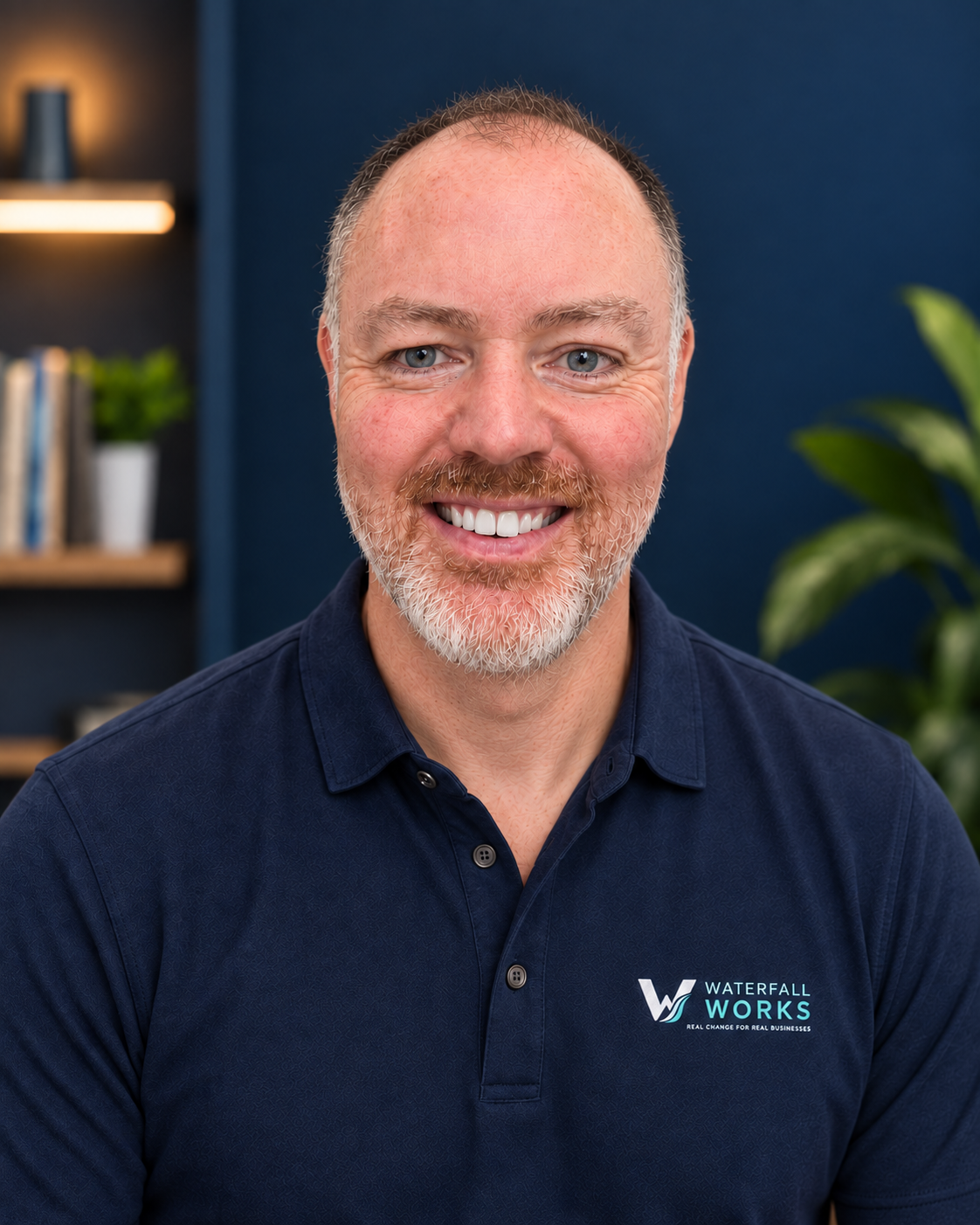
Ed Coppard
Founder, Waterfall Works
Waterfall Works is an operations, process and AI automation consultancy founded and led by Ed Coppard — thirty years of hands-on operational experience since 1997, built from inside real businesses, not from the outside looking in.
“There's real pride in actually delivering something, not just recommending it. I've built my whole reputation on outcomes, not presentations.”
RETIREMENT ADVANTAGE
The foundation
Nearly two decades at Retirement Advantage took Ed from frontline operations through technical roles, team leadership and operational management, running several functions along the way. It's where he learned what high performance actually looks like: strong teams, properly managed, running on disciplined process and clear ownership — nothing more complex than it needs to be.
LIVEMORE CAPITAL
Building from scratch
When LiveMore Capital launched as a new mortgage lender, Ed was one of the first four people involved, helping shape the operation from a blank page. He designed and delivered the end-to-end customer and broker portal from scratch, shaped how the wider operation would run, and built a capacity-planning tool that went on to support hiring and growth decisions as the business scaled — proof he can build an operation, not just improve one already in place.
JUST GROUP
Investigation to live delivery
At Just Group, Ed took a complex, regulated pensions operation from investigation to live running in around five months — mapping how it worked, designing the new way of working, then carrying it through requirements, testing, implementation and training. He stayed on afterwards, delivering a steady stream of enhancements as the operation bedded in. Diagnosis is only half the job; Ed sees it through.
Beyond these, Ed's career has taken in work with organisations including AJ Gallagher, PEN/Phoenix, Bupa, OneFamily, TurkishBank, Friends Life and People's Partnership — spanning process design, operational controls, capacity and workflow, systems, testing, implementation and management information. It's why Waterfall Works doesn't look at operational problems from one narrow angle.
Thirty years, now focused on your business.
That experience now comes directly to Waterfall Works clients — no layers, no hand-offs. The person who understands the problem is the person doing the work.
Finding out what's wrong costs nothing. Fixing it is never a surprise.
These are the same three shapes of problem from How Far We Go — here's roughly what they tend to cost.
Here's how a quote like that actually gets put together:
Free conversation
Tell us what's going wrong, in plain terms — no forms, no sales pitch, no jargon to wade through first. It's a genuine conversation, usually 20–30 minutes, and there's no cost or obligation attached to it. If it's not something we can help with, we'll tell you that too.
A clear picture, then a quote
We ask the right questions — on a follow-up call, or by looking at how the work happens today — until we're confident we understand the real cause, not the symptom. Then you get a fixed quote: what's included, how long it'll take, and often more than one option so you can weigh the trade-offs.
You choose
Take your time — there's no pressure to decide on the call, and no pressure to pick the biggest option. Once you choose, we agree a start date and get on with it. If a smaller change reveals a bigger opportunity later, that's a new conversation, not something you're locked into now.
Every quote is fixed, fully explained, and always your decision — no hard sell, guaranteed.
Before you get in touch, here's what people usually ask.
Waterfall Works is founder-led, which means it's built for small businesses — ones where a single person can genuinely understand the whole operation, not an enterprise that needs a delivery team. If you're not sure whether that's you, the free conversation will make it obvious either way.
That's normal, and it's usually where we start. Most engagements begin with tracing a symptom back to its actual cause — you don't need to arrive with a diagnosis already done. That's the job.
Some consultancies charge just to tell you what's wrong — sometimes hundreds of pounds before you've even decided whether to go ahead. Here, that conversation and the diagnosis behind your quote cost nothing. You only pay once you choose to move forward, and if we conclude there's nothing worth doing, we'll tell you that for free too.
No. AI and automation are tools we use when they're the right fix, not the default answer. Sometimes the real fix is a process change, clearer ownership, or better data, and sometimes it needs no technology at all. The problem decides, not the tool.
Almost always, yes. Make and n8n connect to hundreds of common business tools, so the aim is to work with what you've already got, not replace it. If you're not sure whether your specific setup is compatible, just ask on the call — it's a two-minute answer.
We'll always give you an estimate before we start. But our priority is doing the job properly and thoroughly, not hitting an arbitrary deadline — and because we work to a fixed fee, not a day rate, we take exactly as long as it needs to make sure you get exactly what was promised.
It completely depends on the job, and how much investigation is needed to really understand what's going on. A lot of it can be done remotely — Teams calls, screen recordings, screen sharing — but if getting to the bottom of a process means being there in person, we'll do that too.
A straightforward conversation about what's not working and why — no pitch, no pressure. If there's a clear way we can help, we'll say so; if there isn't, we'll say that too. Either way, you'll leave with a clearer picture of the problem than you started with.
Every engagement includes a support period after delivery, so we stay close while the change beds in. And once that period ends, we don't disappear — we're still easy to reach if something needs a second look.
Because that's the actual approach: do the proper thinking first, design the right solution properly, then build it. Building is the easy part — solving the problem properly, in depth, before you start, is what most people skip. Every successful project we've ever delivered has followed exactly that order.
Tell us what's slowing you down.
Send a message or book a call — whichever's easier. The first conversation is free either way, and there's no obligation. We'll tell you honestly whether it's something we can help with.
No cost, no obligation — and if you're nearby in West Sussex, we're always happy to meet for coffee instead of a call.
“Would I work with Ed again? In a heartbeat.”
Jason Davies, Chief Operating Officer
What's manual, repetitive, or not working the way it should?
A couple of lines is plenty — but the more you share, the better we can prepare before we get back to you.
Want to see how we work first? See an example →